
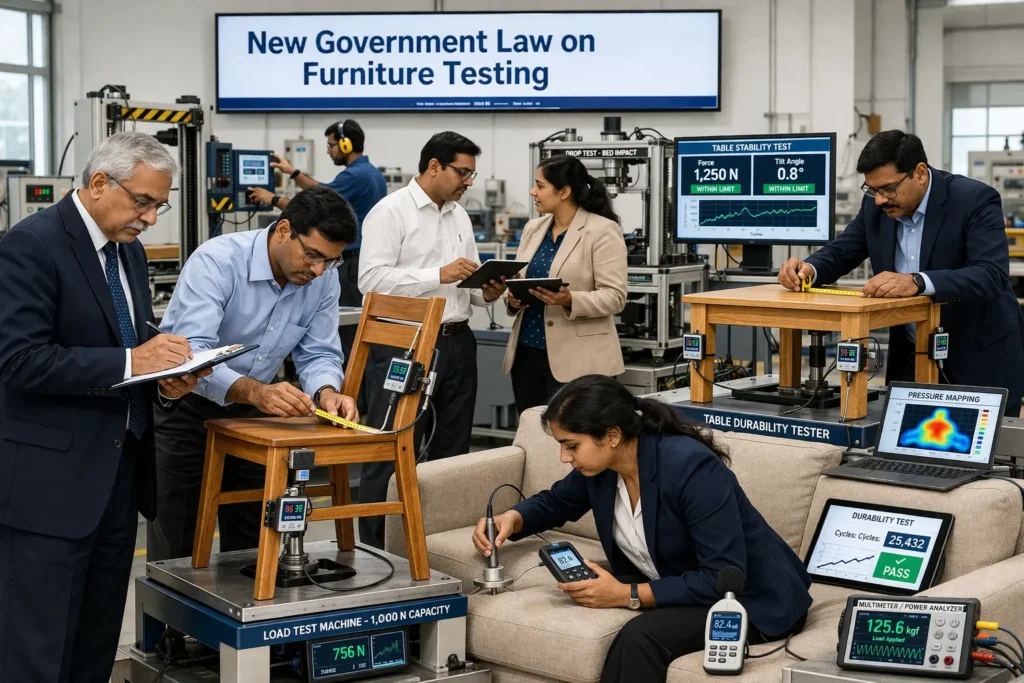
New Furniture Testing Law: Everything You Need to Know
If you sell, make, or import furniture in India, there is a new rule you cannot ignore. The government has made it compulsory for furniture products to be tested and certified before they can be sold in the market. This rule is backed by the Bureau of Indian Standards commonly known as BIS and it applies to everyone in the furniture business, big or small.
Why Did the Government Make This Rule?
Walk into any local market and you will find furniture sold at very cheap prices. It looks fine from the outside, but the quality is often poor. Chairs break within months, bed frames become wobbly, and the materials used can even be harmful to health. Sitting on a poorly made chair for hours every day can cause back pain, neck problems, and long-term posture issues.
On top of that, India was seeing a huge inflow of low-cost imported furniture that undercut local manufacturers who were genuinely trying to make good products. This was unfair to honest businesses and dangerous for consumers.
The government stepped in to fix this. The answer was simple — set a quality standard, test every product against it, and only allow certified furniture to be sold in India.
What Exactly Is the New Law?
The Ministry of Commerce and Industry released the Furniture (Quality Control) Order, 2025 on 13 February 2025. As per this order, it is now mandatory for furniture manufacturers and importers to get BIS certification before their products can enter the Indian market.
Only products carrying the ISI Mark — which is given after successful BIS certification are legally allowed to be manufactured, imported, sold, or distributed in India. This is not a suggestion. It is a binding legal requirement.
A transition period of 12 months was given to allow businesses to prepare and comply. However, that window is closing fast.
Who Does This Apply To?
This law applies to:
- Furniture manufacturers operating in India
- Importers bringing furniture from other countries
- Retailers and distributors selling furniture in the Indian market
- MSMEs making furniture on a small or medium scale
Even if you are a small workshop making wooden chairs or a retailer who sources furniture from other states, this rule affects you.
The BIS Indian Standard Codes You Need to Know
This is the part most businesses overlook until it’s too late. Every furniture category has a specific IS code under which it must be tested. Here are the key ones covered under the Furniture (Quality Control) Order, 2025:
| Furniture Category | IS Code |
| Work Chair | IS 17631:2022 |
| General Purpose Chairs and Stools | IS 17632:2022 |
| Tables and Desks | IS 17633:2022 |
| Storage Units | IS 17634:2022 |
| Beds | IS 17635:2022 |
| Double Decker Beds (Bunk Beds) | IS 17636:2022 |
Each of these codes defines the exact tests your product must pass — covering structural strength, durability, finish quality, safety, and dimensional accuracy. You cannot self-declare compliance. The product must physically pass lab testing under the applicable IS code.
How Does BIS Certification Work?
The process is straightforward if you plan it properly.
Step 1 — Find Your Applicable Standard: Every furniture category has a specific Indian Standard code. For example, bunk beds come under IS 17636:2022. You need to identify which standard applies to your product.
Step 2 — Get Your Product Tested: Send your furniture samples to a BIS-recognised laboratory. The lab will test the product for strength, durability, finish quality, and safety. This is the most important step.
Step 3 — Apply for BIS Certification: Once your product passes the tests, you apply to BIS. They review the test reports and check your manufacturing process.
Step 4 — Factory Inspection: A BIS officer may visit your factory to verify that your production process matches what was tested. Surprise inspections can also happen after certification.
Step 5 — Get the ISI Mark: Once approved, you receive the licence to use the ISI Mark on your products. This mark tells every buyer that your furniture meets national quality standards.
Step 6 — Renew on Time: The certificate does not last forever. You will need to renew it periodically, usually every one to five years.
What If You Do Not Comply?
The consequences are serious. Anyone who manufactures, sells, stores, or imports furniture without proper BIS certification can face a fine of at least ₹2 lakh. In repeat cases or serious violations, imprisonment is also possible under the BIS Act, 2016.
Your goods can also be seized, and your business reputation takes a major hit once legal action begins.
Special Relief for Small Businesses
The government understands that not every furniture maker is a large company. MSMEs have been given a slightly extended timeline to comply. Small enterprises were given until July 2025, and micro units until October 2025. But even those deadlines have now passed or are very close. If you have not started the process yet, there is no more time to wait.
What Should You Do Right Now?
Start by identifying which Indian Standard applies to the furniture you make or sell. Then contact a BIS-approved testing laboratory and get your samples tested. The sooner you begin, the smoother the process will be.
This new law is not meant to trouble honest businesses. It is designed to protect consumers and reward manufacturers who take quality seriously. If your furniture is genuinely good, getting certified should not be difficult.
Final Thought
The Indian furniture market is growing fast. Demand is rising, design standards are improving, and consumers are becoming smarter buyers. In this environment, the BIS certification is not just a legal requirement — it is a mark of trust that sets your brand apart. Use this law as an opportunity, not a burden, and your business will be better for it.